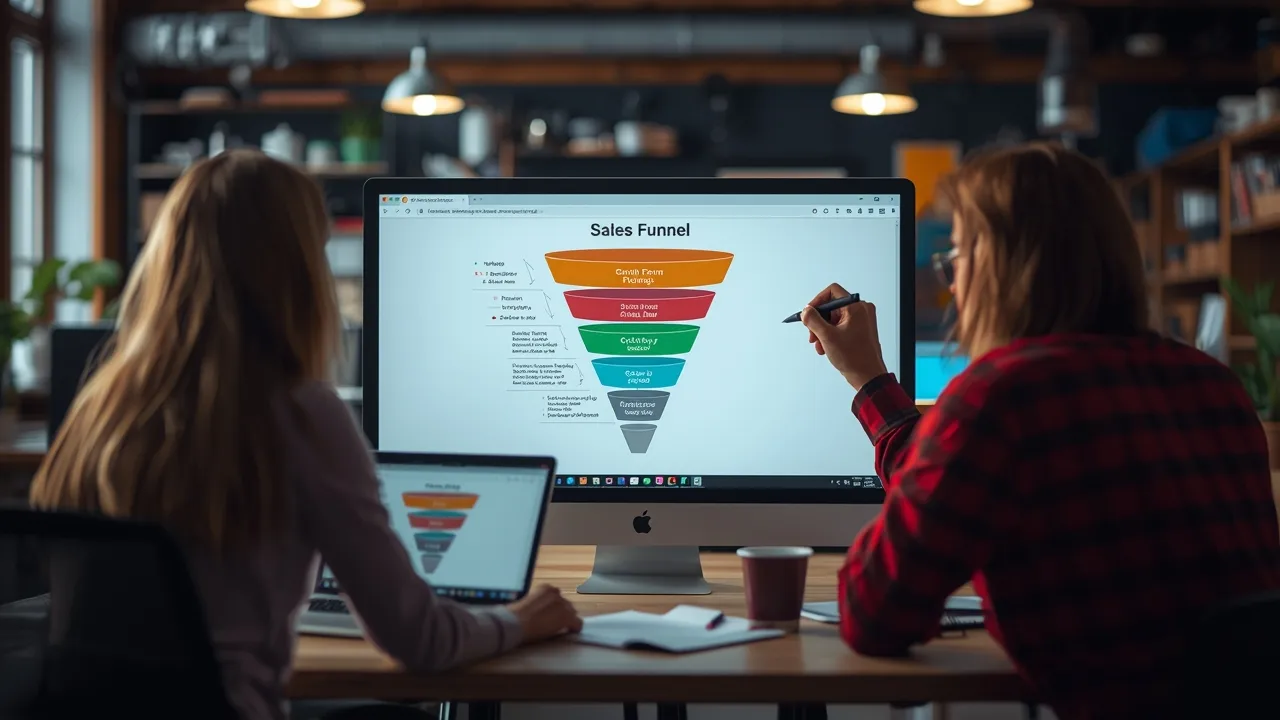
A sales funnel is the path a stranger takes to become a subscriber or customer. A website is the place where that path lives. Beginners often treat them as separate projects and end up overbuilding one before the other works. This page covers how the two fit together, what to build first, where beginners get stuck, and where to go next. It is published by Funnel Foundry and leans on Systeme.io as the working example. Features and pricing change, so confirm current details on the official Systeme.io site before you commit.
What a funnel is, in plain terms
A funnel is a short sequence of pages with one goal. A typical one looks like this:
- A page that offers something. This is usually a free resource in exchange for an email address, or a direct sales page.
- A page that takes action. This is an opt-in form or a checkout.
- A page that confirms and guides. This is a thank-you page that tells people what happens next.
- Follow-up. This is usually email, sent automatically.
Nothing about this is magic. It is a deliberate order of pages with fewer distractions than a normal website. No funnel guarantees sales, and results depend on your offer, your audience and your traffic.
Funnel or website: which do you need first?
If you have one offer and want to test it, start with a funnel. A full website with a blog, an about page and a menu can wait. If you already have several products or a service business, you will probably want both, and the funnel becomes one part of the site.
- Funnel first: you are selling one thing, collecting emails, or validating an idea.
- Website first: people need to find out who you are before they trust you, or you have many offers to organize.
- Both: you have traffic coming from several places and need a home base plus focused landing pages.
A common mistake is spending weeks on design before anyone has seen the offer. A plain page that clearly says who it is for and what they get beats a polished page that is vague.
Which funnel type to build first
Most beginners need only one of the types below. The table is a rough guide, not a rule. For a longer explanation, read Sales Funnel Types Explained: Which One to Build First.
| Funnel type | Best for | Main trade-off |
|---|---|---|
| Lead magnet (opt-in) | Building an email list before you have a product | Needs follow-up emails, and a list takes time to pay off |
| Direct sales page | One clear offer for a warm audience | Cold visitors may not be ready to buy immediately |
| Low-priced offer with add-ons | Turning first-time buyers into customers | More pages and more setup to test |
| Webinar or event | Higher-consideration offers that need explaining | You have to produce and present the content |
If you are unsure, a lead magnet funnel is usually the lowest-risk start, because it teaches you the tools and builds a list while you work out your offer.
The basic build process
Here is the order that causes the least rework.
- Write the offer in one sentence. Say who it is for, what they get and why they should care. If you cannot, fix that before touching a builder.
- Pick one goal per funnel. It should be either "collect emails" or "make a sale," not both.
- Choose a template and edit it. Starting from a template is faster than a blank page. Change the copy first and the design second.
- Connect your payment or email tools. Test every step yourself, including the confirmation emails.
- Add follow-up. Even a short automated email sequence is better than none.
- Publish, send a small amount of traffic, and look at what happens. Change one thing at a time.
For a hands-on walkthrough, follow How to Build Your First Sales Funnel in Systeme.io, Step by Step.
The pages that do the heavy lifting
The sales page
This is where most of the persuading happens. It should state the problem, show the offer, explain what is included, answer likely objections and make the next step obvious. Keep claims honest. If you have no testimonials yet, leave them out rather than inventing any. See How to Build a Sales Page That Converts in Systeme.io for layout and editing guidance.
The checkout and add-ons
An order bump is a small extra offered on the checkout page. An upsell is a follow-up offer shown after purchase. Both can raise the value of each order, but they can also annoy buyers if they are pushy or irrelevant. Offer only what genuinely complements the main product. The setup is covered in How to Set Up a Checkout Flow with Order Bumps and Upsells in Systeme.io.
Your domain
A custom domain makes your pages look more professional and builds trust. It is not required to get started, so you can test on a default address first. When you are ready, How to Connect a Custom Domain to Systeme.io explains the steps. Check whether your plan supports custom domains before you buy one.
Where the funnel connects to the rest of your business
A funnel on its own is only a few pages. It becomes useful when it feeds something else:
- Email: most funnels depend on follow-up. Read Email Marketing & Automation for how sequences and automations work.
- Products: if you are selling a course, template or ebook, see Online Courses & Digital Products.
- Affiliate income: if you promote other people’s products, see Affiliate Marketing & Online Business Setup. Check each program’s rules about how links may be used and disclosed.
Is Systeme.io the right tool?
It is an all-in-one platform, meaning funnels, email and other tools sit in one account instead of being stitched together from several services. The upside is simplicity and fewer logins. The trade-off is that all-in-one tools may not match a specialist tool in every area, such as design flexibility or advanced automation. Whether that matters depends on what you are building.
If you are weighing it up, these pages give a fuller picture:
- Systeme.io Funnel Builder Review: Templates, Page Editor and Real Limits looks at the builder itself.
- Systeme.io Reviews, Pricing & Verdicts covers cost and overall fit. Pricing and plan limits change, so confirm them on the official site.
- Systeme.io Alternatives & Comparisons helps if you want to compare other platforms before choosing.
Common beginner mistakes
- Building too much. One funnel with one goal is enough to learn from.
- Skipping testing. Go through your own funnel as a buyer, on a phone as well as a computer.
- Ignoring traffic. A good funnel with no visitors produces nothing. Plan how people will find it.
- Copying someone else’s claims. Promise only what you can deliver, and check the rules where you sell, including tax and consumer-protection requirements. For legal or tax questions, consult a qualified professional.
- Judging too early. A handful of visitors tells you very little. Wait for enough traffic before changing course.
All supporting guides at a glance
Step-by-step guides
- How to Build Your First Sales Funnel in Systeme.io, Step by Step
- How to Build a Sales Page That Converts in Systeme.io
- How to Set Up a Checkout Flow with Order Bumps and Upsells in Systeme.io
- How to Connect a Custom Domain to Systeme.io
Choosing and comparing
- Sales Funnel Types Explained: Which One to Build First
- Systeme.io Funnel Builder Review: Templates, Page Editor and Real Limits
- Systeme.io Reviews, Pricing & Verdicts
- Systeme.io Alternatives & Comparisons
Related topics
- Email Marketing & Automation
- Online Courses & Digital Products
- Affiliate Marketing & Online Business Setup
A sensible next step
Pick one offer, choose the simplest funnel type that fits it, and build it from a template this week. Then read the funnel builder review to check that the tool’s limits will not get in your way. Nothing here guarantees results, but a small, working funnel will teach you more than a perfect plan.
In this section
Systeme.io is an all-in-one platform, and the funnel builder is one of its core parts. This review covers wha…
Read GuideSysteme.io Website Builder Review: Can It Run a Simple Business Site?Short answer: Systeme.io can probably run a simple business site if your goal is to explain what you offer, c…
Read GuideSales Funnel Types Explained: Which One to Build FirstA sales funnel is a short path that moves a visitor from "just looking" to a specific action, usually joining…
Read GuideHow to Build Your First Sales Funnel in Systeme.io, Step by StepA sales funnel in Systeme.io is a series of connected pages that move a visitor toward one action, usually a…
Read GuideHow to Build a Sales Page That Converts in Systeme.ioA sales page has one job: help the right person decide whether to buy, without confusing or pressuring them.…
Read GuideHow to Set Up a Checkout Flow with Order Bumps and Upsells in Systeme.ioAn order bump and an upsell both raise the value of a single purchase, but they work at different moments. Th…
Read GuideSysteme.io Funnel Templates: How to Choose and Customize ThemSysteme.io funnel templates are pre-built sets of connected pages (for example an opt-in page and a thank-you…
Read GuideHow to Connect a Custom Domain to Systeme.ioConnecting a custom domain means your funnel or site loads at an address like www.yourbrand.com instead of a…
Read AnswerWhat is the difference between a landing page and a sales page?A landing page has one narrow job: get a visitor to take a single small action, usually joining an email list…
Read AnswerHow many funnels and pages can you build on the Systeme.io free plan?Short answer: Systeme.io has offered a free plan with limits on how many funnels and pages you can build, but…
Read AnswerCan you A/B test pages in Systeme.io?Yes, Systeme.io has offered a split-testing feature for funnel pages, but features and plan access change, so…
Read AnswerCan you build a webinar funnel in Systeme.io?Yes, you can build a webinar funnel in Systeme.io. The basic pieces are a registration page, a thank-you page…
Read AnswerDoes Systeme.io have SEO settings for pages and blog posts?Yes, Systeme.io includes basic SEO settings for pages and blog posts. You can typically set things like a pag…
Read